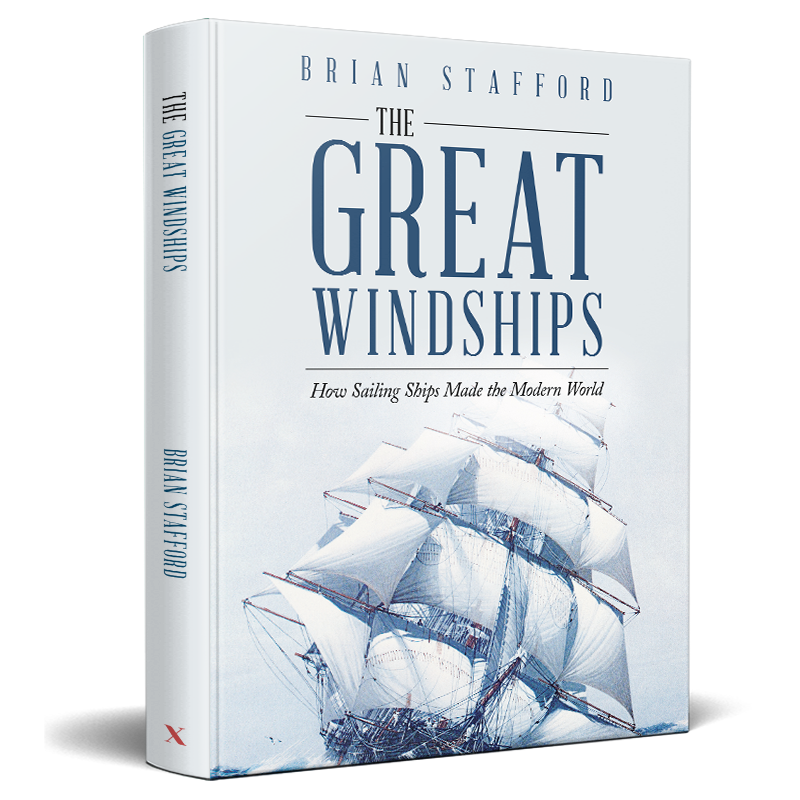
The following is an extract from Alan Villiers' book The Way of a Ship. It is about the famous Laeisz Flying 'P' liner, Preussen. She was a fully rigged five-masted steel windjammer - the biggest merchant vessel of the classic era of sail. She is discussed in my book, but what is interesting here are the details of a subsequent tank test done on her hull, which estimated that to move 8000 tons of cargo through the sea at 17 knots (her top speed), her rig was generating 6000 horsepower.
.... They saw that the ship to windward was a five-masted, full-rigged ship. She was lying over a little, with her lee scuppers awash, and the sea was gushing from her wash-ports. She was a great lofty vessel with masts 200 feet high, towering above the sea, dwarfing the little barque whose astonished apprentices counted forty-three sails, all set magnificently and pulling like horses.The flag at the short gaff on the aftermost mast was German. The name on the high flared bows was Preussen. As she passed and drew steadily ahead, they could read her name on the shapely counter, and her port of registry. Preussen, Hamburg, they read.
Before the watch was out, the great five-master was a pin-point on the horizon, again this time ahead. No one aboard the little Limejuice barque would ever forget the grace and glory of that great ship racing past them while they lived. There was one Preussen only - a super ship, a swift giantess among all sailing ships, the ultimate expression of deepwater Sail.
The five-masted, full-rigged ship Preussen was the only ship of her type ever built. She was a steel ship 433 feet long with a beam of nearly 54 feet, displacing over 11,000 tons and carrying 8,000 tons of cargo. She was propelled entirely by her 60,000 square feet of canvas, and the only power aboard her was for working her cargoes and raising her heavy anchor when she was getting under way. She set thirty square sails, six on each mast, and fifteen to eighteen fore-and-afters. Her main yard was over 100 feet long. Her best speed was a shade over seventeen knots - no more. Tank experiments made with a model of her, years after the ship herself was lost, showed that, to shift her 8,000 tons of cargo through the sea at a speed of seventeen knots, her sails had to develop more that 6,000 horse-power. The whole great fabric of her tremendous driving power was controlled by a crew of forty-seven officers and men. Excepting perhaps the steward, cabin boy, and two cooks, every one of those was a sailor in the true sense of that word. Her master was a veteran of the Laisez Flying 'P' Line, a man trained in the Potosi under the genius Hilgendorf. ......