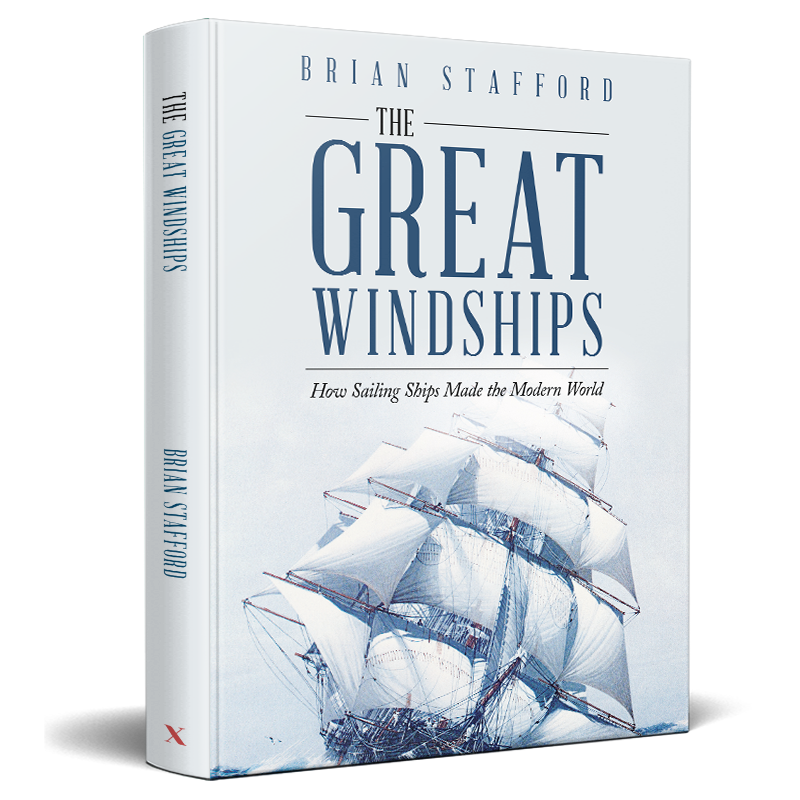
Readers, having read my book, sometimes ask me what other books on sailing I found interesting during my research, and that I would recommend.
In my experience, the best sea adventure books tend to be autobiographical and record actual events. One of the best is The Last Grain Race by Eric Newby. He wrote about a voyage he made to Australia when he was only eighteen years old, just before the Second World War. He crewed on the great windjammer, Moshulu, which sailed from London in ballast to a port in Spencer's Gulf in South Australia to load wheat, after which it made the return voyage to England following the ‘Clipper Route’ around Cape Horn. The quality of the writing is very good, and Newby went on to make a very successful career in travel writing.
Another is Sailing Alone Around the World by Joshua Slocum. Sailing alone around the world is a commonplace event these days, with nevertheless highly courageous sailors in state-of-the-art craft, assisted by all sorts of electronic technology. Slocum was the first person to achieve the feat. The differences are that he made the voyage in a derelict boat that he re-built himself and re-named Spray. He had nothing but an alarm clock he bought in a second-hand shop to keep time. He had no chronometer set on GMT to help him determine his longitude. Slocum was no foolhardy mariner who just happened to be lucky. He was an experienced maritime master, and when, on a previous voyage, his ship was wrecked in Argentina with only his wife and son as crew, he built another ship on the beach from the wreckage of the old one and sailed it home to Maine. He later told the story of this adventure in another book entitled The Voyage of the Liberdade. Joshua Slocum was the very model of nineteenth-century seamanship and self-reliance.
A fourth autobiographical work and perhaps one of the best sailing books drawn from life and from a literary point of view is Richard Dana’s Two Years Before the Mast. It has survived the passage of time as a work of considerable literary value and a great piece of sea adventure literature. Somewhat incongruously, Dana didn’t spend two years crewing a sailing ship as an ordinary seaman, as the title suggests. Much of the time was spent onshore on the coast of California when it was still a Spanish colony. Dana was a promising student about to further his studies at Harvard when it was decided that his somewhat weak constitution would benefit from a long sea voyage. His ship and its master left a good deal to be desired, and the destination involved rounding Cape Horn. Dana survived this arduous journey, writing absorbing about the conditions and his captain and shipmates. He also wrote knowledgeably about the seamanship, and sometimes lack of it, he witnessed along the way. His difficulty was that, once on the West Coast, he was somewhat stranded and, not wanting to return on the same ship, he spent a good deal of time onshore preparing cow hides for shipment back east, before scoring a much better berth for the voyage home. What I found most enjoyable about this book, besides the quality of the writing, is his recounting of his return as a successful retired lawyer, to what was by then part of the USA. There, he meets many of the people he had known as a young man and writes endearingly about those he most admired during his earlier sojourn.
By contrast, fictional sea books and books about ships and sailing abound, to the point where it is almost an industry in itself. Most of the genre differ from The Great Windships in that they recount tales of sea adventures on warships and mostly in the British Navy.
Probably chief among these is C.S. Forester’s series that follows the fortunes of a fictional officer in the British Navy who rises from obscurity and without patronage by dint of strong personal qualities and a wide range of abilities. Forester is credited with creating the naval historical novel despite avoiding any accusations of historical inaccuracy by having his hero off on some other mission at times of critical battles during the Napoleonic Wars. His fictional adventures range over some seventeen novels during which he rises from a sea-sick midshipman without connections, to Admiral of the Fleet.
Another series of maritime novels that follow the life and adventures of a similarly fictitious naval officer at the time of the Napoleonic Wars. They are Patrick O’Brian’s 20-novel series based on the imagined lives of fictional English naval officer, Jack Aubrey and Irish-Catalan ship’s surgeon, Stephen Maturin. Unlike Forester’s Hornblower, O’Brien incorporates his protagonists into major historical events of the Napoleonic era in such a way as to avoid affecting the outcome.
One of what I consider was one of the best books on sailing that I read was one I read when I was just getting into the sport. It was entitled simply ‘Sailing’ and it was first published in 1949 by Penguin as part of a series of Penguin Handbooks on pursuing a number of active pastimes. As well as advising on how to choose a boat or yacht and buying it, it embraces fitting it out and racing it, all in simple language – an ideal book for the beginner. Although written for the English reader, its lessons on how to actually sail a boat are timeless. The text was charmingly interspersed with poems, sea shanties, delightful sketches, - some instructive and others purely whimsical, and (now outdated) photographs. Many involved classes that have since passed into history. Heaton also covers buoyage, simple navigation and the international ‘rules of the road’ at sea.